Disclosure: As an Amazon Associate, HomeCharging.org earns from qualifying purchases. Links below go to current Amazon search results, not fixed prices. More.
Level 1 may be enough if your daily driving is modest and your EV can stay plugged in for much of the night. The U.S. Department of Transportation estimates about 2–5 miles of range per charging hour for Level 1 and 10–20 for Level 2; ENERGY STAR says Level 2 averages about four times the miles per hour and is 10% more efficient. DOT charging-speed guidance and ENERGY STAR describe typical estimates, not a guarantee for every car.
How Level 1 and Level 2 differ
Level 1 uses a standard 120-volt AC outlet. Many EVs come with a portable cordset for it, so if a suitable outlet is already available where you park, you may not need to buy a separate charging unit or arrange an installation. The U.S. Department of Energy’s Alternative Fuels Data Center (AFDC) says the outlet must be on a dedicated branch circuit for this use.
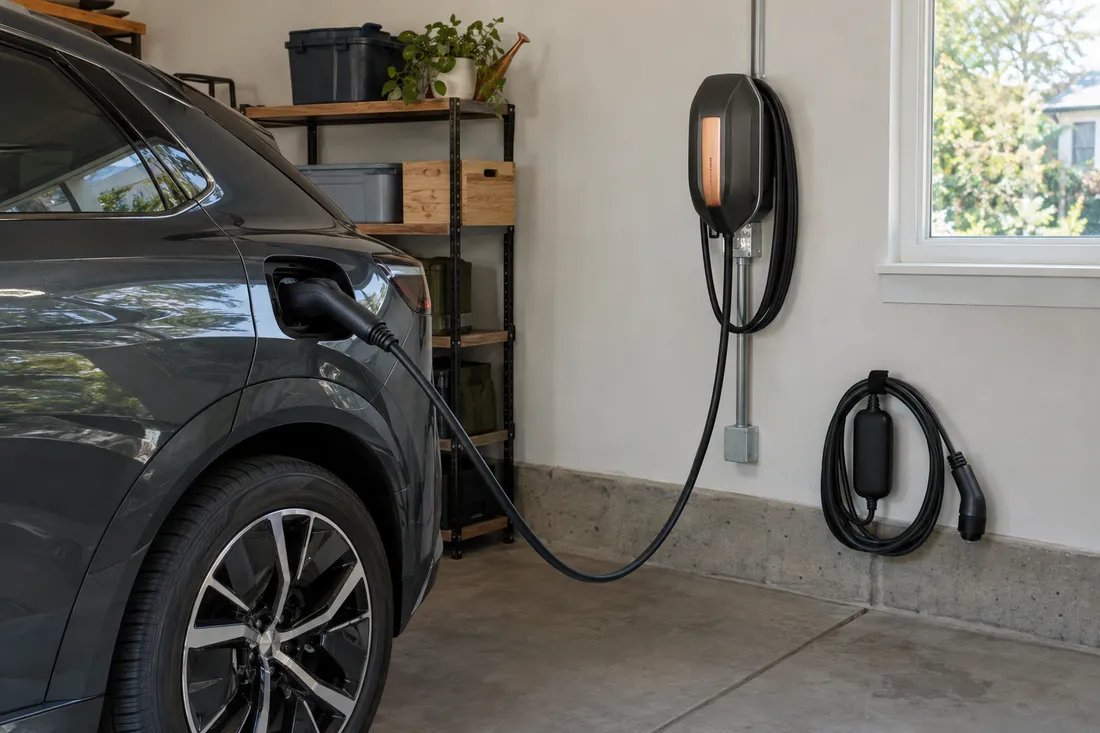
Level 2 uses 240-volt residential electrical service. It requires compatible charging equipment, and installing it may require electrical work. Both types add energy to your battery, but Level 2 generally does so faster. Actual speed depends on the vehicle and charging equipment, so treat published miles-per-hour estimates as a guide, not a promise for your specific car.
The vehicle also affects how much range you get from the energy it receives. A car that uses more electricity to travel the same distance will gain fewer miles from a given amount of charging than a more efficient car. For an explanation of charging power and units, see our guide to EV charging speeds, kW, amps, and voltage.
Level 1 is often appealing for its simplicity. Level 2 is more useful when you need to replace more of your daily driving energy during the time your car is parked at home, or when you want to replenish a larger battery more quickly.
Speed and efficiency: what the published estimates mean
DOT gives estimated electric range added per charging hour of 2–5 miles for Level 1 and 10–20 miles for Level 2. Its general charging table lists typical power outputs of about 1 kW for Level 1 and 7–19 kW for Level 2. Those estimates vary with the vehicle, battery, equipment, temperature, and other conditions; your car’s display is a better guide to its current charging rate.
Another AFDC page gives an approximate estimate of 5 miles per hour for Level 1 and 25 miles per hour for Level 2. It notes that its Level 1 estimate assumes 1.9 kW. These estimates are not identical to DOT’s range, which is a reminder that charging speed varies by vehicle and assumptions. See the AFDC overview of charging levels for its figures.
ENERGY STAR says Level 2 charging is, on average, 10% more efficient than Level 1 and adds approximately four times more miles per hour of charging. This is an average comparison, not a guarantee that every Level 2 setup will deliver exactly four times the range or reduce your bill by a fixed amount. Your electricity rate, vehicle efficiency, and charging habits affect the cost.
For a broad sense of time, DOT says Level 1 can take 40–50 or more hours to charge a battery-electric vehicle from empty to 80%, compared with 4–10 hours for Level 2. Those are general estimates, not a prediction for an individual model. Our guides to Model 3 charging times and home charging for Model Y cover vehicle-specific options.
Use your daily miles to see if Level 1 is enough
Start with the distance you drive on a typical day, then compare it with the range your car can add while parked at home. Using AFDC’s approximate Level 1 estimate of 5 miles per charging hour, 20 miles of driving would take about 4 hours of charging to replace: 20 ÷ 5 = 4. Replacing 40 miles would take about 8 hours: 40 ÷ 5 = 8. These are simple estimates, not guaranteed charge times.
For comparison, using AFDC’s approximate Level 2 estimate of 25 miles per hour, the same 20 miles works out to roughly 0.8 hours, and 40 miles to roughly 1.6 hours. Again, the car and equipment affect real results. You can also use DOT’s broader per-hour ranges from the table below if you want a more cautious estimate.
Think about your routine, not just your average. If your car is parked and plugged in for long periods overnight, Level 1 may recover enough range for your regular driving. If you often drive farther than usual, have short home parking windows, or need to recover a lot of range after a busy day, Level 2 offers more flexibility.
Build in a margin rather than planning around the fastest estimate. Cold weather can reduce EV range and increase energy use, so a routine that works in mild conditions may feel tighter in winter. The federal FuelEconomy.gov cold-weather guide explains those effects and recommends preheating while the vehicle is plugged in.
Level 1 vs. Level 2: a practical comparison
| What to compare | Level 1 | Level 2 |
|---|---|---|
| Residential supply | 120 V AC | 240 V AC |
| Estimated range added per hour | 2–5 miles | 10–20 miles |
| Typical setup | Portable cordset and suitable existing outlet | Level 2 charging equipment; installation may be needed |
| Good fit | Lower daily mileage and long home parking time | Longer or less predictable driving and shorter home parking time |
| Main trade-off | Low setup burden, slower charging | Faster charging, added equipment and possible installation cost |
Use the table as a starting point, not a ranking. A household outlet that is not suitable for charging, or is not on a dedicated branch circuit, is not a reason to plug in anyway. Check your vehicle’s charging instructions and have a qualified professional assess the outlet and circuit.
Level 2 is not automatically better for every home. If Level 1 consistently replaces the energy you use before the next drive, faster charging may not add much practical value. If you regularly need to charge more than Level 1 can replenish during your parking time, the added convenience may justify the cost.
The equipment itself also varies. Some Level 2 products provide basic status information, while more advanced models may include scheduling or communications features. Compare the features you will use, connector compatibility, and the electrical supply available at your parking spot before buying.
Gear for this guide
Level 2 EV charger
A search can help compare connector compatibility and features; confirm your electrical setup and have a licensed electrician assess installation before buying.
See options on AmazonCheck that any charger or cordset is safety certified (ENERGY STAR lists certified models) and matches your outlet and your car's connector.
Compare the equipment and installation costs
Level 1 can avoid an equipment purchase or installation cost when you already have an appropriate outlet at your parking location. That does not make the electricity free: your home’s electricity rate and how much energy your vehicle uses still matter. AFDC explains that EV energy use can be expressed in kWh per 100 miles and that charging cost depends on the electricity price and vehicle efficiency.
For residential Level 2, AFDC lists charger equipment costs of $380–$690 and an approximate installation cost of $1,300 per connector, not including labor and permitting costs. Adding those listed figures gives roughly $1,680–$1,990 before any excluded labor or permit costs. This is a broad estimate, not a quote for your home; the electrical system and job details can change the final amount. See AFDC’s charging infrastructure cost information.
Ask for a written estimate that separates equipment from electrical work and identifies any permit costs. Check with your local building or permitting office about requirements. Electrical work should be done by a licensed electrician, and the local code and permit office decides what approvals apply. AFDC notes that some homes may have insufficient electrical capacity for Level 2 equipment, and a qualified electrician can assess whether a circuit can be added.
To compare ongoing costs, use your utility’s rate and your car’s energy consumption rather than assuming that one charging level always costs less. Some utilities offer time-of-use rates, so charging at different times may affect your bill. For a deeper walkthrough of the home charging cost calculation, visit our guide to EV charging costs at home.
Check the outlet, equipment, and installation requirements
Before relying on Level 1, confirm that the outlet is appropriate for EV charging and on a dedicated branch circuit. Follow the vehicle manufacturer’s charging guidance. If the outlet, cord, or connection becomes damaged or you have concerns about the electrical setup, stop using it and contact a licensed electrician rather than attempting electrical repairs yourself.
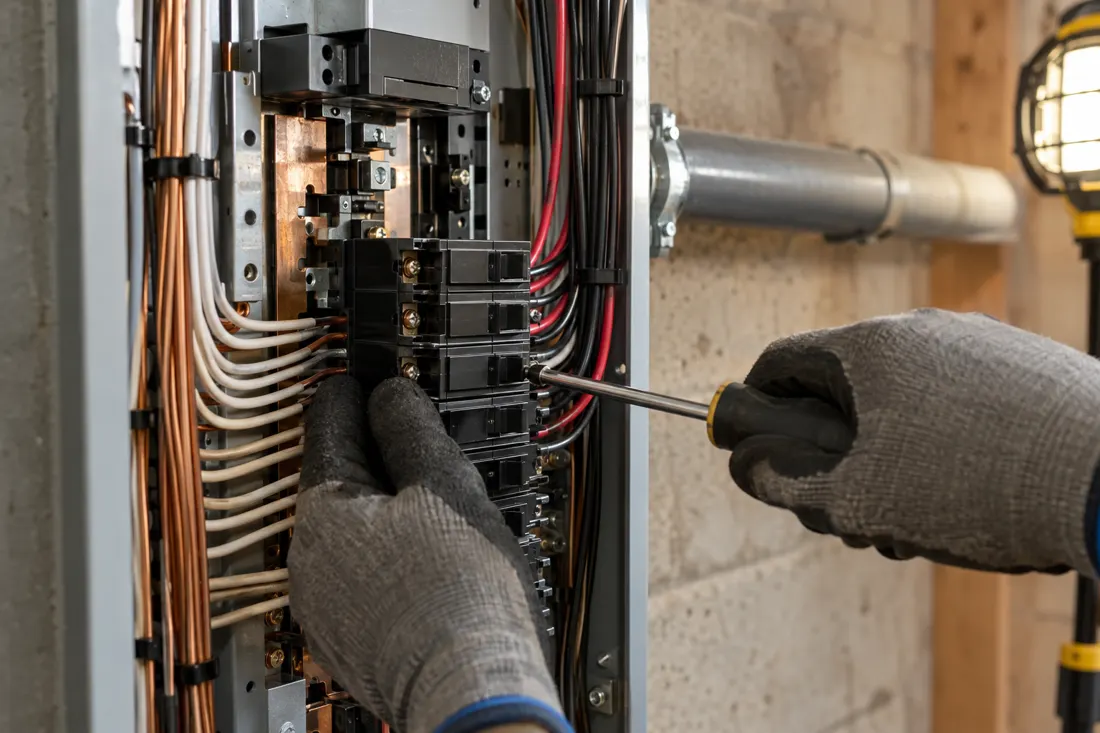
For Level 2, confirm that the selected equipment works with your vehicle and that the home’s electrical capacity can support the proposed installation. A licensed electrician should evaluate the work and handle electrical installation. Local and state rules apply, and permits may be required; your local code and permit office determines the requirements for your location.
AFDC says residential charging equipment can be used outdoors, including in rain, when the equipment is outdoor-rated. If your parking spot is outside, check the equipment’s rating and the manufacturer’s instructions before purchase. ENERGY STAR also recommends choosing safety-certified equipment; it says ENERGY STAR-certified chargers are tested for safety by a nationally recognized testing laboratory.
Some Level 2 chargers offer scheduling features, which can be useful if your utility has time-based rates. ENERGY STAR notes that some connected models may support utility programs. Check with your utility to see whether an applicable rate or program exists, and read the installation and compatibility details for the specific charger you are considering.
Which home charging level should you choose?
Choose Level 1 if your daily driving is modest, your vehicle is parked at home long enough to recharge, and you have a suitable outlet on a dedicated circuit. AFDC says many EV owners can meet daily driving needs with overnight Level 1 charging when an appropriate outlet is available near the parking location. If your real routine confirms that, you may not need to pay for a faster setup.
Choose Level 2 if your commute or other regular driving uses more range than Level 1 can replace in your home parking window, if your schedule changes often, or if your vehicle has a large battery that takes longer to replenish. These are among the situations AFDC identifies as reasons to consider Level 2. Faster charging can also give you more flexibility when an unexpected trip changes your plans.
If you are uncertain, try tracking how much range you use in a normal week and how much your car restores while plugged in. Compare that with the charging estimate for your vehicle and the amount of time it is usually parked at home. You can calculate charging time using our EV charging speed calculator, then compare an electrician’s quote with the convenience Level 2 would add.
The best choice is the one that fits your driving and your home’s electrical setup. You can start with a suitable Level 1 cordset if it meets your needs, then consider Level 2 if your routine changes or the slower charging becomes a limitation. Check your vehicle manual and use a licensed electrician for an installation assessment.
FAQ
Is Level 1 charging enough for everyday driving?
It can be. AFDC says many EV owners can meet daily driving needs by charging overnight with Level 1 if a suitable outlet on a dedicated branch circuit is available. Compare your daily miles with the range your car adds while parked; charging estimates vary by vehicle and conditions. AFDC home charging guidance covers when Level 1 may be sufficient.
How much faster is Level 2 than Level 1?
DOT estimates 2–5 miles of range per hour for Level 1 and 10–20 miles per hour for Level 2. ENERGY STAR describes Level 2 as adding approximately four times more miles per hour on average and being 10% more efficient. Your actual charging speed depends on the vehicle and equipment. DOT speed estimates
How much does it cost to install Level 2 charging at home?
AFDC lists residential Level 2 charger equipment at $380–$690 and an approximate installation cost of $1,300 per connector, excluding labor and permitting costs. The listed figures add to roughly $1,680–$1,990 before those exclusions, but your quote may differ. Ask a licensed electrician to assess the work and check local permit requirements. AFDC cost information
Does Level 2 charging use less electricity?
ENERGY STAR says Level 2 charging is, on average, 10% more efficient than Level 1. That is an average comparison, not a guarantee of a particular household bill reduction. Your vehicle’s energy use, electricity rate, and charging schedule also affect cost. Some utilities offer time-of-use rates, so check your utility’s current terms.
Can I use Level 1 or Level 2 charging outdoors?
AFDC says residential charging equipment can be installed outdoors and used in rain, provided outdoor installations use outdoor-rated equipment. Check the equipment’s rating and the vehicle and charger instructions. Have a licensed electrician assess any electrical installation, and check with your local code and permit office about requirements.
Sources
- EV Basics: Charging Speeds, U.S. Department of Transportation
- Electric Vehicle Charging Stations, Alternative Fuels Data Center
- Electric Vehicle Chargers, ENERGY STAR
- Electric Vehicles and Cold Weather, FuelEconomy.gov
- Developing Infrastructure to Charge Electric Vehicles, Alternative Fuels Data Center
- Charging Your Electric Vehicle at Home, Alternative Fuels Data Center
Written by the HomeCharging.org editors
We build each guide from primary sources: the U.S. Department of Energy, DOT, EIA, ENERGY STAR, the IRS and manufacturer support pages. We do not lab-test chargers or vehicles, and we say so. Numbers link to where they came from. Last checked November 9, 2026. How we research.